
In partnership with

Hey future-proof friends 💜
I really feel like 2025 was kind of the end of life (or career) as we know it. Like nothing will ever be the same.
And I’m sure 2026 will serve up even more crazy changes at breakneck speed, especially when it comes to the job market, which is changing more than most people even realise.
Skills in AI-exposed jobs are now changing 66% faster than they were just last year, according to PwC's 2025 Global AI Jobs Barometer (and that hits especially deep for me as a Copywriter!!)
To stay relevant in this kind of environment, we need to work smarter, not harder.
And a big part of working smarter is building AI skills that can open up more opportunities for yourself and create more leverage - not just at work, but outside of it too.
So that’s what we’re diving into in this newsletter.
But before we dive in:
Want to get the most out of ChatGPT?

ChatGPT is a superpower if you know how to use it correctly.
Discover how HubSpot's guide to AI can elevate both your productivity and creativity to get more things done.
Learn to automate tasks, enhance decision-making, and foster innovation with the power of AI.
TL;DR - today’s lineup:
One Serious Deep Dive 💡: The 6 AI skills that will separate people who thrive in 2026 from people who get left behind (based on research from McKinsey, PwC, and World Economic Forum)
Copy-Paste Prompt 🤖: The "Skills Gap Audit" prompt that shows you exactly which AI skills you need to learn next
Piping Hot AI Tea 🫖: Armed robotic dogs with rifles marching in India, an AI-generated song hitting #1 in Sweden (then getting disqualified), Apple's screenless AI pin prototype, and OpenAI burning through $14 billion in 2026
💌 Your say genuinely shapes this newsletter: there’s a one‑click feedback poll at the very end. I genuinely check for feedback like a maniac after I send this out because I really want to know what you honestly think. So thank you!
One Serious Deep Dive 💡
6 AI Skills That Will Future-Proof Your Career in 2026
Let’s do a quick fire round of important stats you need to digest:
Workers with AI skills are earning 28% more than those without them (PwC).
AI-related job postings grew 88% in 2025 (Ravio).
And only 43% of workers are regularly using AI at work, which means there's a massive opportunity for anyone willing to actually learn this stuff (Indeed).
But most people don't know which AI skills actually matter (there’s A LOT that fits under that umbrella).
Good news is the most valuable AI skills for most people aren't technical. They're about knowing how to use AI as a partner to amplify what you already do well.
Based on research from McKinsey, PwC, World Economic Forum, and LinkedIn, here are the 6 AI skills that will actually future-proof your career.
1. AI Fluency & Prompt Engineering
This is the foundation. If you can't communicate effectively with AI, nothing else matters.
Prompt engineering isn't about being clever with words. It's about understanding how AI interprets instructions and structuring your prompts to get the output you actually need.
This skill applies to anyone using ChatGPT, Claude, Gemini, or any AI tool.
The better you get at prompting, the faster you work. The faster you work, the more valuable you become.
How to build this skill:
Study what makes prompts work (context, constraints, examples, output format)
Save prompts that work really well in a prompt library you can reuse
Take a course on prompt engineering (IBM and Google both offer free ones)
Use prompting frameworks like RISEN:

RISEN prompting framework by Kyle Balmer
2. Critical Evaluation of AI Outputs
This is a BIG ONE that’s also MASSIVELY UNDERRATED. AI is incredibly good at sounding confident while sometimes being completely wrong.
The World Economic Forum ranks critical thinking and AI output evaluation among the most resilient skills in AI-augmented workplaces. As AI gets better, the ability to verify, fact-check, and evaluate what it produces becomes even more important.
This means knowing when AI is hallucinating, when it's oversimplifying, when it's missing context, and when it's just confidently wrong.
Here’s a good framework to help you do this:

3. AI-Powered Automation
This is the ultimate way to scale your output.
I automated my entire video posting process across 7 platforms using Notion and n8n:

It not only slashed the time it takes me to distribute one video across multiple platforms, it’s also instantly increased my leverage by increasing my visibility online.
Tools like ChatGPT, Notion AI, Zapier, Make, and n8n let you automate repetitive tasks without needing to code. The skill is identifying what can be automated and building systems that actually work.
How to build this skill:
Map out your weekly tasks and identify repetitive ones
Start with one automation (email responses, content distribution, data entry)
Use no-code tools like Zapier or Make for simple automations
Learn n8n if you want more control and customisation
If you want to learn AI Automations, here’s a great (but long!!) walkthrough on YouTube:
4. AI-Enhanced Content & Work Output
AI shouldn’t replace your creativity - it should amplify it.
It should help you produce higher-quality work faster.
This applies to everything: writing, design, research, analysis, presentations, video editing, coding. AI can handle the first draft, the repetitive parts, the formatting, the research. You handle the strategy, the creative direction, the human touch.
How to build this skill:
Use AI for drafts, then edit to add your voice
Let AI handle research and data gathering while you interpret it
Use tools like Canva AI, Gamma, or Napkin AI for visual content
Learn which tasks AI handles well and which ones need human judgment
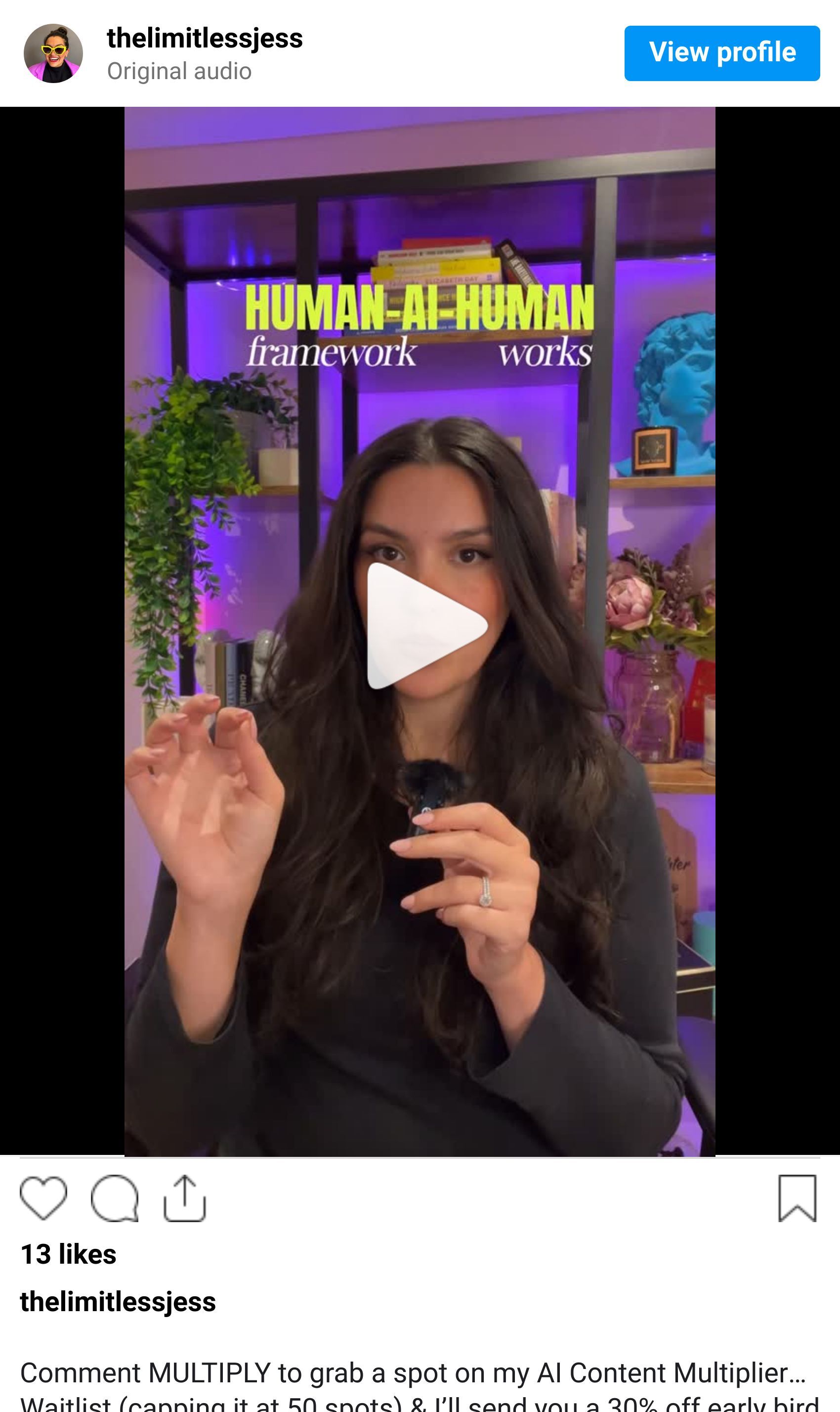
I always follow my Human-AI-Human approach when it comes to using AI for my work:
5. Responsible AI Use & Ethics
As AI spreads, so do concerns about bias, misuse, privacy, and accountability.
Companies are requesting over 100,000 professionals with AI ethics expertise annually, with salaries ranging from $120,000 to $180,000. But you don't need to be an AI ethicist to understand responsible AI use.
This skill means knowing when AI is appropriate, when it's not, how to use it without introducing bias, and how to protect privacy and data.
How to build this skill:
Understand how AI models are trained and where bias comes from
Learn basic data privacy principles
Question AI outputs that seem biased or unfair
Stay informed about AI regulations in your industry
You can learn a bit more about AI ethics and algorithmic bias right here through code.org:
6. Human-AI Collaboration (Knowing When Humans > AI)
The most valuable skill ultimately might be knowing when NOT to use AI.
AI excels at pattern recognition, data processing, and generating content. It struggles with context, nuance, complex tradeoffs, emotional intelligence, and accountability.
The professionals who thrive aren't AI-dependent or AI-resistant. They're the ones who know exactly when to use AI and when to take back control.
How to build this skill:
Experiment with AI across different tasks to learn its limitations
Pay attention to when AI outputs feel off or miss the point
Develop your human skills (judgment, empathy, creativity, strategic thinking)
Treat AI as a collaborator, not a replacement
Want to see how I use AI to 10x my content and audience growth?
I’ve created a done-for-you content ideation, creation, management and publishing system to help you leverage AI to 10x your content creation (without losing your authenticity in the process).
It’s called the AI Content Multiplier and the waitlist is now open - join now and I’ll send you a 30% off early bird discount as soon as it launches (which is soon).

One Powerful Prompt 🤖
The "Skills Gap Audit" Prompt
Use this to figure out exactly which AI skills you need to learn next:
I want to identify which AI skills I should prioritise learning to future-proof my career.

My current role: [your job title/industry]
My goals: [what you're trying to achieve - e.g., "increase income," "work more efficiently," "transition to a new field"]
AI tools I currently use: [list them, or say "none"]
Time I can dedicate to learning: [X hours per week]

Based on this, analyse:

1. **Skills Gap**: Which of the 6 core AI skills (prompt engineering, critical evaluation, automation, AI-enhanced output, responsible use, human-AI collaboration) am I weakest in?

2. **High-Impact Priority**: Which 1-2 skills would have the biggest immediate impact on my work and goals?

3. **Learning Path**: For each priority skill, give me a specific 30-day action plan with concrete steps I can take this week.

4. **Quick Wins**: What's one thing I can do TODAY to start building these skills?

Be specific. Give me actionable steps, not theory.
Piping Hot AI Tea 🫖
1. Armed Robotic Dogs: The Future of Warfare Just Got Real (and Four-Legged)
This isn't a Black Mirror episode anymore. India officially introduced rifle-mounted robotic dogs during its Republic Day 2026 rehearsals. These four-legged autonomous weapons, equipped with Tavor assault rifles, marched alongside human troops, signaling a massive shift in real-world military deployment. While they’re designed for high-risk zones where you wouldn't want to send a human, the sight of armed robots on the streets is a sobering reminder that the line between sci-fi and reality has officially evaporated.
2. AI Topped the Charts in Sweden... Then Got The Boot
Sweden’s most streamed song of 2026, Jag vet, du är inte min, just hit #1 on Spotify with over 5 million streams. But the artist, "Jacub," isn't a person - it’s an AI project from a Danish music company. Once the truth came out, the song was scrubbed from the official national charts. Sweden ruled that human authorship is the non-negotiable line for chart eligibility. The song is still on Spotify, but it doesn't count for the record books. It raises the ultimate question: If the fans love the "vibe," does it actually matter who (or what) wrote the notes?
3. Apple’s Secret AI Pin: Is the Screenless Future Finally Here?
Reports are swirling that Apple is prototyping an AI-powered wearable pin about the size of an AirTag. Think: no screen, just cameras, mics, and a speaker clipped to your shirt. It would use on-device AI to "see" and "hear" your world, responding to voice commands and blending into your life like AirPods do. If this launches in 2027, it signals Apple’s massive push beyond the iPhone into "ambient computing." The big question is: Are we ready to wear a camera pin all day, even if it has an Apple logo on it?
4. OpenAI’s $14 Billion Problem: Is the Runway Running Out?
Despite the hype, the math is getting scary. Internal projections suggest OpenAI is on track to lose a staggering $14 billion in 2026. Between the eye-watering costs of training GPT-5 and the massive server bills to keep ChatGPT running, the financial pressure is mounting. While they’re still the kings of the hill, this kind of burn rate raises serious questions about their long-term financial runway. It’s a high-stakes game of "spend now, profit later" - but $14 billion is a lot of "later."
If you enjoyed today's newsletter AND got to the end of it, I’d love a quick click on the poll below to let me know what you think 💜.
See you next week,
Jess xx
