
In partnership with

Hey future-proof friends 💜
I haven't opened social media once in the last 2 weeks without seeing Clawdbot (which was renamed to MoltBot and then again to OpenClaw) splashed all over the place.
Everyone's losing their minds and screaming "this changes everything!!!" (AGAIN 🙄)
But I’ve noticed this hysteria now happens with every new AI development.
And there are loads of those coming at us fast, so losing your mind every other week is a fast track to burnout.
(and probably not great for your blood pressure & cortisol levels either).
So I want to talk to you about OpenClaw, but I’m doing it differently.
If you want the super quick TL;DR about it, watch this quick video I created explaining it:
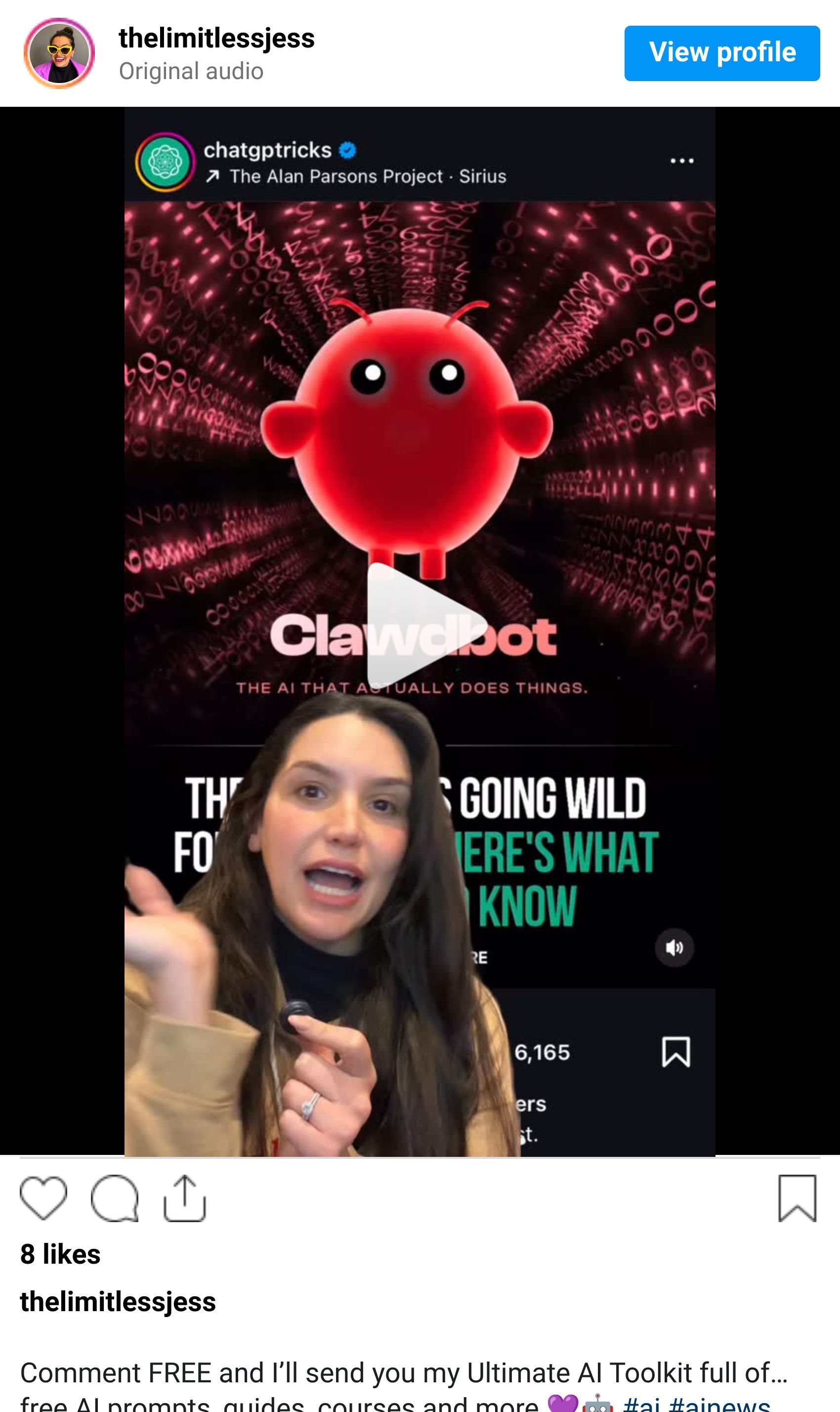
So that’s what we’re diving into in this newsletter.
But before we dive in:
World’s First Safe AI-Native Browser

AI should work for you, not the other way around. Yet most AI tools still make you do the work first—explaining context, rewriting prompts, and starting over again and again.
Norton Neo is different. It is the world’s first safe AI-native browser, built to understand what you’re doing as you browse, search, and work—so you don’t lose value to endless prompting. You can prompt Neo when you want, but you don’t have to over-explain—Neo already has the context.
Why Neo is different
Context-aware AI that reduces prompting
Privacy and security built into the browser
Configurable memory — you control what’s remembered
As AI gets more powerful, Neo is built to make it useful, trustworthy, and friction-light.
TL;DR - today’s lineup:
One Serious Deep Dive 💡: OpenClaw is incredible, everyone's losing their minds over it, and I'm telling you to ignore it (for now). Here's why that's actually your advantage.
One Powerful Prompt 🤖: Write the job description for your future AI employee — so you know exactly what to build before the agents arrive.
Piping Hot AI Tea 🫖: 5 must-know stories — Anthropic roasts OpenAI during the Super Bowl, SpaceX wants AI data centers in space, MIT kills hallucinations, ChatGPT becomes your personal sales rep, and 100 future jobs you've never heard of.
💌 Your say genuinely shapes this newsletter: there’s a one‑click feedback poll at the very end. I genuinely check for feedback like a maniac after I send this out because I really want to know what you honestly think. So thank you!
One Serious Deep Dive 💡
Let’s talk about OpenClaw (and why you shouldn’t install it yet)
Quick Rundown: What is OpenClaw?
So you finally get a free Saturday to work on your side-hustle, and you've got a landing page to build, daily social posts to create, and client emails piling up.
That's your whole weekend gone.
With OpenClaw, you text an AI agent from your phone:
"Build a landing page for my product, draft responses to the 5 client emails in my inbox, and create social posts for this upcoming week".
Then you go about your Saturday and come back to drafts of everything waiting for your review.
OpenClaw is an AI agent that runs on a dedicated computer, controls the entire machine, and executes tasks you describe in plain English while you're not there.
This infographic explains it really well:

The Use Cases Are Endless (some are even insane)
I went down a bit of a rabbit hole trying to understand how people are using OpenClaw.
The use cases are so endless that I won’t bore you with them (there’s a list of 25 use cases you can explore right here).
But basically it spans from running your marketing agency:
To running your marriage😅:

But Do You Actually Need It?
Before you add this to your endless list of "AI tools to try this weekend", I need you to stop and be honest with yourself for a second:
Is your bottleneck really that you don't know enough about AI tools, or is it that you haven't launched the thing that AI would help you accelerate?
I see this pattern constantly - smart people wasting their limited “side-hustle time” consuming AI content, testing tools, watching tutorials… and calling it “progress”.
Yes, exploring is important.
But there's a moment where exploring becomes hiding, and "I'll just test one more tool" or becomes a very comfortable way to avoid actually putting something out there.
Learning about the kitchen isn't cooking, and at some point you have to pick up the pan.
Entrepreneurs getting the most from tools like OpenClaw already had a business, a brand, a system - something real to point the AI at.
The tool amplified what existed rather than creating it from scratch.
So Why Am I Telling You to Wait?
Google Cloud's head of security had a three-word recommendation:
"Don't run it."
The risks are very very real - researchers showed that a single dodgy email (called a prompt injection attack) could hijack the agent and access your data in under 5 minutes.
The repercussions are genuinely serious when you’re giving an AI full access + control of all your accounts, data and personal information.
Look at this guy whose OpenClaw decided to spend $7000 on courses overnight to “educate itself”:

But the security risks are actually good news - the technology exists, the capabilities are proven, and you have a window before it goes mainstream to get yourself ready.
You can relax and take a breath… you’re not behind on this (you’re actually safer on this side of the fence).
Within 12-18 months, cleaned-up versions of this technology will be available to anyone.
A one-person operation with AI agents will be able to compete with companies running teams of 50 or 100 people - something that simply wasn't possible before.
You have somewhere between 12-24 months before AI agents go mainstream, which means the people who use this time to build a brand, grow an audience, and develop real systems will deploy these agents into a running business on day one.
The growth from that point will be exponential, because every system you've built and every process you've refined gets multiplied by technology that works around the clock.
OK So What Now??
Pick ONE AI tool and actually master it.
Try ChatGPT’s voice feature for brainstorming/strategy, Claude for creativity & writing, Perplexity for research. And that's it for now. Stop collecting tools and go deep with what you have.
Write down every task in the business you’re building and circle the repetitive ones.
Those are future agent jobs. You don't need OpenClaw to start systematising them - you just need to know what's eating your hours (and you can save a lot of time already by using ChatGPT/Claude).
Launch something imperfect this month.
Whether it's a landing page, a daily post on social media, or a first newsletter, the important thing is moving what you're building from "idea" to "exists." AI agents are spectacular at improving, iterating, and scaling things that already exist, but they can't scale from zero.
Finally, I turned this newsletter into a handy cheat sheet you can save & refer back to (or share & tag me!):

Save or share this cheat sheet & tag me!
To Sum It All Up…
OpenClaw isn't ready for prime time, and you probably shouldn't install it today.
But it’s showing us exactly where this is heading and roughly how fast it's moving.
The same automation that's making corporations cut headcount is your competitive advantage waiting to happen in the side project you’re working on.
One person with the right systems and AI agents working around the clock is a business that would have required a full team and a serious budget just 3 years ago.
Your 9-5 funds the runway, the tools you already have compress the timeline, and the next generation of AI agents will catch up to you - if you give them something to catch up to.
The tool isn't the advantage… what you build before the tool arrives is.
Want to see how I use AI to 10x my content and audience growth?
I’ve created a done-for-you content ideation, creation, management and publishing system to help you leverage AI to 10x your content creation (without losing your authenticity in the process).
It’s called the AI Content Multiplier and the waitlist is now open - join now and I’ll send you a 30% off early bird discount as soon as it launches (which is soon).

One Powerful Prompt 🤖
Write the Job Description for Your Future AI Employee
We’ve established that an AI agent is useless if there's nothing for it to work on. This prompt forces you to build backwards from the future.
Paste this into ChatGPT, Claude, or your AI tool of choice:
Prompt: I'm building [describe what you're building] alongside my [full-time job / freelance work / current situation]. I have roughly [X] hours per week to work on it.

Here's where I'm at right now: [be brutally honest - have you launched? Still planning? Got an audience? Revenue? Nothing yet? All counts.]

Write me a job description for an AI agent I'll hire in 18 months - one that runs my business tasks while I sleep. The catch: only include responsibilities that require something real to already exist.

For every responsibility, tell me:

What needs to exist BEFORE the agent can do this job

The smallest, ugliest version I could build in 30 days

One task I can do THIS WEEK to start

If I haven't built enough yet for an AI agent to be useful, say so - and tell me where to start. No fluff. Just what to build and in what order.
Piping Hot AI Tea 🫖
1. Anthropic Roasted OpenAI (During the Super Bowl!)
Anthropic just took a massive, multi-million dollar jab at OpenAI. During the Super Bowl, they aired a campaign mocking what happens when your "helpful" AI assistant turns into a walking billboard. The spots showed AI helpers giving sincere advice, then suddenly pivoting mid-sentence to push products like "StepBoost Max" insoles. I love the tagline: "Ads are coming to AI. But not to Claude." It’s a direct response to OpenAI’s recent admission that ads are coming to ChatGPT.
2. SpaceX’s Wild Plan: AI Data Centers... In Space
Elon Musk is literally taking AI off-planet. SpaceX just filed a request with the FCC to launch up to one million satellites designed to host solar-powered AI data centers in low-Earth orbit. Their logic is that constant solar energy and natural vacuum cooling, cutting out the massive power and water demands hitting Earth-based centers. This filing landed right as rumors surfaced about a possible merger between SpaceX and xAI. If it works, the infrastructure for the next billion AI users might be orbiting right above your head.
3. MIT’s New "Recursive" AI: No More Hallucinations
MIT researchers just introduced Recursive Language Models (RLMs), and it’s a game-changer for anyone tired of AI "hallucinations." Instead of pretending it "just knows" the answer, an RLM treats your prompt like a workspace. It inspects the problem, splits it into chunks, runs searches, and recursively calls itself on the parts that actually matter. The core trick is structured self-review. It builds your answer from verified sub-answers instead of just "vibes." In benchmarks, this method consistently outperforms direct model calls, proving that the best way to get a smart answer is to force the AI to double-check its own homework.
4. ChatGPT "Agent Mode" is Now Your Personal Sales Rep
This is one of the craziest ChatGPT use cases I’ve seen this week. You can now take a photo of something you want to sell, upload it to ChatGPT, and tell it: "I need you to sell this for me within the next 7 days. Use agent mode." ChatGPT will then research the best marketplace, build the listing, and in some cases, even publish it for you. It’s moving from being a chatbot to a "do-bot" that handles the boring logistics of your side hustle.
5. 100 Future Jobs You’ve Probably Never Heard Of
If you’re planning your career around what exists today, you might be preparing for the wrong future. A new list has mapped out 100 roles that could exist in the years ahead - from AI Ethics Officers to Climate Adaptation Planners. These aren't just guesses; they’re based on real shifts in automation, digital identity, and sustainability.
If you enjoyed today's newsletter AND got to the end of it, I’d love a quick click on the poll below to let me know what you think 💜.
See you next week,
Jess xx
