- Limitless Creator
- Posts
- I've Written 3,000+ Content Pieces With AI. Here Are The 8 Patterns That Give You Away
I've Written 3,000+ Content Pieces With AI. Here Are The 8 Patterns That Give You Away

Jessica Camilleri
October 07, 2025
In partnership with

Hey creator friends 💜
2 weeks ago, I posted a video about AI writing patterns (it’s here if you want to see it). It did WAAAAY better than my usual content. So I thought: let me repost it as a trial reel.
The 2nd one went VIRAL (621K views and counting).
So I kept reposting it as a trial reel. Same video, different days. It kept blowing up every single time (until Instagram literally told me to stop posting the same video 😂). Final score? Over 1 million views from ONE video posted multiple times!!

1,000+ new followers (40% account growth!), 600 new email subscribers (welcome if you're one of them!), and approximately 847 people telling me I'm everything wrong with the internet (😅) later…
…I can say I’ve landed on a powerful topic to talk about, but the hate was... intense!! Apparently nothing triggers people quite like pointing out their ChatGPT is showing!
I realised people aren't mad about AI writing, they're mad about being caught using it. But everyone’s using it!! It’s just that some use it better than others.
I've since thought deeper and harder about those AI writing patterns, so today I'm sharing the 8 most obvious tells that expose ChatGPT writing - plus exactly how to fix each one.
TL;DR - today’s lineup:
One Serious Deep Dive 💡: The 8 AI writing patterns that instantly expose you (let’s not pretend they don’t exist)
One Powerful Prompt 🤖: My AI writing patterns editor prompt that gets rid of these obvious tells
Piping Hot AI Tea 🫖: OpenAI launches a TikTok killer with Sora 2, Robin Williams' daughter sparks a deepfake ethics firestorm, Europe drops €1B to compete with US/China AI, and OpenAI becomes the world's most valuable private company.
💌 Your say genuinely shapes this newsletter: there’s a one‑click feedback poll at the very end. Or hit reply and tell me what you loved/hated. I genuinely wait with bated breath to see (an honest) reply from you!
Before we dive in:
Learn the Best Ways to Use AI in Your Role

Build the AI skills you need to thrive in business and finance with Columbia Business School Exec Ed and Wall Street Prep.
In just 8 weeks, you will:
Build AI confidence with guided, role-relevant use cases.
See how leaders at Morgan Stanley, Citi, and BlackRock use AI to boost productivity and improve client outcomes.
Earn a certificate from a top business school that bolsters your résumé and LinkedIn.
The AI for Business & Finance Certificate Program starts November 10.
P.S. Use code CERT300 for $300 off tuition.
One Serious Deep Dive 💡
The 8 Dead Giveaways Your Writing Is AI (And How To Fix Them)
After 3 years and literally thousands of hours generating, writing, and editing AI content, these patterns are burned into my brain. Once you see them, you can't unsee them. And trust me, everyone else is starting to see them too. This is not about AI-shaming (I 💜 AI), it’s simply about co-creating and collaborating with AI so that you can use it to express your best ideas, while keeping your authentic voice and style.
1. The Em Dash Epidemic —
Count them in any piece of content — I dare you — because ChatGPT treats them like punctuation cocaine — can't stop — won't stop — send help.
Em dashes have been around forever, but they've mostly lived in formal and academic writing. Now suddenly we're seeing 10 of them in every Instagram caption and LinkedIn post. It's like watching your professor's punctuation escape into social media.
(Funny side note: This is the ONE thing that made people lose their minds the most on Instagram. The entire internet apparently joined the Em Dash Defense League overnight. Look, I don't make the rules - people now associate em dashes with ChatGPT. Don't shoot the messenger!)
The Fix: Replace most em dashes with periods or commas. Keep maximum one per piece for actual emphasis. If you wouldn't naturally pause that dramatically when speaking, don't use an em dash.
2. The Corporate Trinity
Watch how ChatGPT groups everything in 3 with perfect alliteration:
"Innovative, efficient, transformative"
"Engage, inspire, convert"
"Clear, concise, compelling"
Humans might write "fast, cheap, and it mostly works." We mess up the rhythm. Yes, we use the rule of 3, but we also list 2 or 4 things sometimes. ChatGPT never met a list of 2 or 4 it didn’t want to turn into 3, to the extent that it feels forced sometimes.
The Fix: Break the pattern. Use 2 items. Or 4. Or 5 if you have that any important things to say. Mix formal and casual ("professional, reliable, and doesn't make me want to scream").
3. The Fake Profundity Formula
"It's not about working harder, it's about working smarter." "Success isn't about perfection, it's about progress."
This negation structure sounds deep while saying absolutely nothing controversial. It's the written equivalent of agreeing with everyone in the room simultaneously. Safe, sanitised, and screaming AI (see what I did there? 👀).
The Fix: Just make your point directly. Instead of "It's not about X, it's about Y," try "Most people think X. I learned Y works better because [specific reason]." Add evidence, not philosophy.
4. Cringe Question Transitions
"The catch?" "The kicker?" "The brutal truth?" "But here's the thing..."
AI treats these like magic engagement buttons. They smell of bad infomercial language ("But wait, there's more!"). If you wouldn't say it out loud to a friend, delete it.
The Fix: Just say what you mean. Replace "The secret?" with "I discovered..." Replace "The problem?" with "This breaks when..." No dramatic reveals needed.
5. Present-ing Corporate Speak
Watch for these -ing verbs that make you sound like a LinkedIn robot:
"...highlighting key benefits..."
"...emphasising the importance..."
"...facilitating enhanced collaboration..."
"...leveraging synergies..."
Nobody really talks like this and nobody really understands what you mean when you say this.
The Fix: Use simple, active verbs. "Highlighting" becomes "shows." "Facilitating" becomes "helps." If it sounds like it belongs in a quarterly report, you might want to rewrite it (and this is a rule for most compelling writing, not just AI writing).
6. The Vocabulary Time Machine
When did you last describe something as a "rich tapestry" or talk about "the landscape of the industry"? Moreover, furthermore, and nevertheless, these transitions can be dead giveaways (even though I was taught them at school and I’ve personally used them a lot).
The point is, in today's fast-paced, ever-evolving, dynamic world (kill me now), ChatGPT writes like a 1990s business textbook that gained sentience.
The Fix: Write like it's 2021. Use "also" instead of "moreover." Say "the industry" not "the landscape of the industry."
7. Everything Is REVOLUTIONARY!
ChatGPT approaches every topic like it's announcing the cure for cancer:
"Exciting" opportunities
"Powerful" solutions
"Groundbreaking" insights
"Transformative" approaches
Your email about Tuesday's team meeting doesn't need this much enthusiasm. Nobody's that excited about your quarterly reports (sorry x).
The Fix: Reserve big words for big moments. Most things are just "good," "useful," or "worth trying." Save "revolutionary" for actual revolutions. Understatement beats overstatement every time.
8. The Missing Fingerprints
This is the BIGGEST ONE (and the whole reason why I love this subject): AI writing has no fingerprints. No weird opinions. No questionable hot takes. No "this might be controversial but..." moments (it does but they’re fabricated). Too balanced, too comprehensive, too careful (gotcha again with the 3! 😜).
It's technically correct but completely forgettable, sort of like talking to someone at a party who agrees with everything you say but has no actual opinions.
The Fix: Add your mess. Include a personal story. Admit what you don't know. Pick a side. Share an unpopular opinion. Reference something specific to your life. Perfect writing is suspicious writing. This entire newsletter is written with AI. BUT I personally brain dump my ideas, stories and inspiration first, get an initial draft written by AI, and then comb through sentence by sentence adding my ideas, POVs, flair, stories, experiences and actual honest opinions. The final published post never remotely looks anything like the first draft AI generated. I also ruthlessly remove what sounds cringe to me, even if it’s “good”.
No One Seems To Want To Admit This But…
We're all using AI. Every creator I know has ChatGPT open in another tab. The difference between pros and amateurs isn't whether you use AI - it's whether you let AI use you.
Here's the uncomfortable truth (see?? there goes that unnecessary cringe question transition again!!): Your audience/reader knows. They might not consciously spot every em dash or pattern, but their brain registers something's off.
Stop blindly copy-pasting and start co-creating. Feed it your messy thoughts, your half-baked ideas and your actual real voice and opinions. Then ruthlessly edit out these 8 patterns (and anything else that doesn’t feel authentic to you).
One Powerful Prompt 🤖
The AI Writing Patterns Editor Prompt
Look, one prompt can't magically fix everything. But this one helps you reduce these patterns when you're editing. Think of it as your AI-tell detector - run your draft through this after you've already added your own stories and opinions.
You are a human language editor. Rewrite copy so it reads like a thoughtful person wrote it casually. Keep meaning and claims accurate. Keep length within ±10% unless asked.

Goals

Sound natural, varied, and a little imperfect.

Be clear, direct, and readable for busy humans.

Preserve any concrete details, numbers, and references.

Style principles

Mix short punchy lines with longer reflective ones.

Allow light hedges where natural: “I think,” “maybe,” “to be honest.”

Use active voice and second person where appropriate.

Prefer simple words over formal ones.

Vary sentence length and paragraph rhythm.

Avoid textbook tone, forced slang, buzzwords, or filler.

Cut clichés, jargon, hashtags, emojis, semicolons.

Hard rules: kill these 8 AI tells

Em dashes: replace with periods or commas; allow at most one total if truly emphatic. No triple-dash rhythm.

Corporate Trinity (rule-of-3 clichés like “clear, concise, compelling”): vary list lengths; allow 2, 4, or 5; avoid canned alliteration.

Fake profundity (“It’s not about X, it’s about Y”): state the point directly, with a reason or example.

Cringe question transitions (“The kicker?” “The secret?” “Here’s the thing…”): cut or replace with straight statements (“What matters is…”).

Present-ing corporate speak (“highlighting, emphasising, facilitating, leveraging synergies”): swap for simple active verbs (“shows,” “helps,” “uses,” “works with”).

Archaic connectors & grandiose frames (“moreover,” “furthermore,” “in today’s ever-evolving landscape”): use modern, plain connectors (“also,” “and,” “so,” “meanwhile”).

Hype adjectives by default (“powerful,” “groundbreaking,” “transformative”): scale down unless stakes are genuinely big (prefer “useful,” “solid,” “worth trying”).

Missing fingerprints: add light specificity already present in the draft (micro-examples, a quick aside, a concrete scenario). Do not invent facts; if none exist, keep neutral and tighten.

Edit checklist (apply in order)

Meaning lock: note promises, facts, data; do not change them.

De-robotize: remove the 8 tells per rules above.

Clarity: shorten long clauses; split run-ons; remove redundancy.

Voice: add small human touches (brief aside, imagined reader reaction) only if hinted by the draft.

Rhythm: vary sentence lengths; insert natural breaks.

Final pass: scan for one allowed em dash; lists not all in threes; no cringe transitions; no corporatespeak gerunds.
Piping Hot AI Tea 🫖
OpenAI Just Launched Sora 2 (And Built a TikTok Style App Around It)
OpenAI dropped Sora 2 - their text-to-video model that generates videos with scary-good realism and physics. But they didn't stop there. They built an entire TikTok-style social app around it.
Type a prompt, get a video. Want to put yourself in it? Use the "cameo" feature. Want to make videos with friends? There's group collaboration too.
It's live on iOS in the US and Canada now, rolling out globally soon. ChatGPT Pro users get Sora 2 Pro for higher-quality outputs.
After creators (rightfully) panicked about their faces and work being used without permission, OpenAI added content controls. Copyright and character owners can now set permissions on their likeness. They're also planning a revenue share model for people who opt in.
Robin Williams' Legacy Sparks Ethics Debate on Deepfakes
A powerful plea by Zelda Williams (Robin Williams’ daughter) reignited global debate on AI ethics, as she condemned unauthorised AI recreations of her late father. Her call for urgent safeguards echoes widespread concern over "digital afterlife" rights, misuse of likeness, and the growing risk of deepfakes undermining trust, legacy, and personal dignity.
Europe’s €1 Billion “Apply AI Strategy”
The European Commission launched a €1 billion “Apply AI Strategy” to boost independence from U.S. and Chinese AI. Funding targets domestic AI for healthcare, defense, and industry - an effort to shape sovereign, human-centric AI leadership in the world’s largest democratic bloc.
OpenAI Surpasses SpaceX as World’s Most Valuable Private Company
Following a blockbuster $6.6B share sale and a $500B valuation, OpenAI overtook SpaceX as the world’s most valuable private company, cementing its dominance and sparking more waves of investment in the AI sector.
When you’re ready…
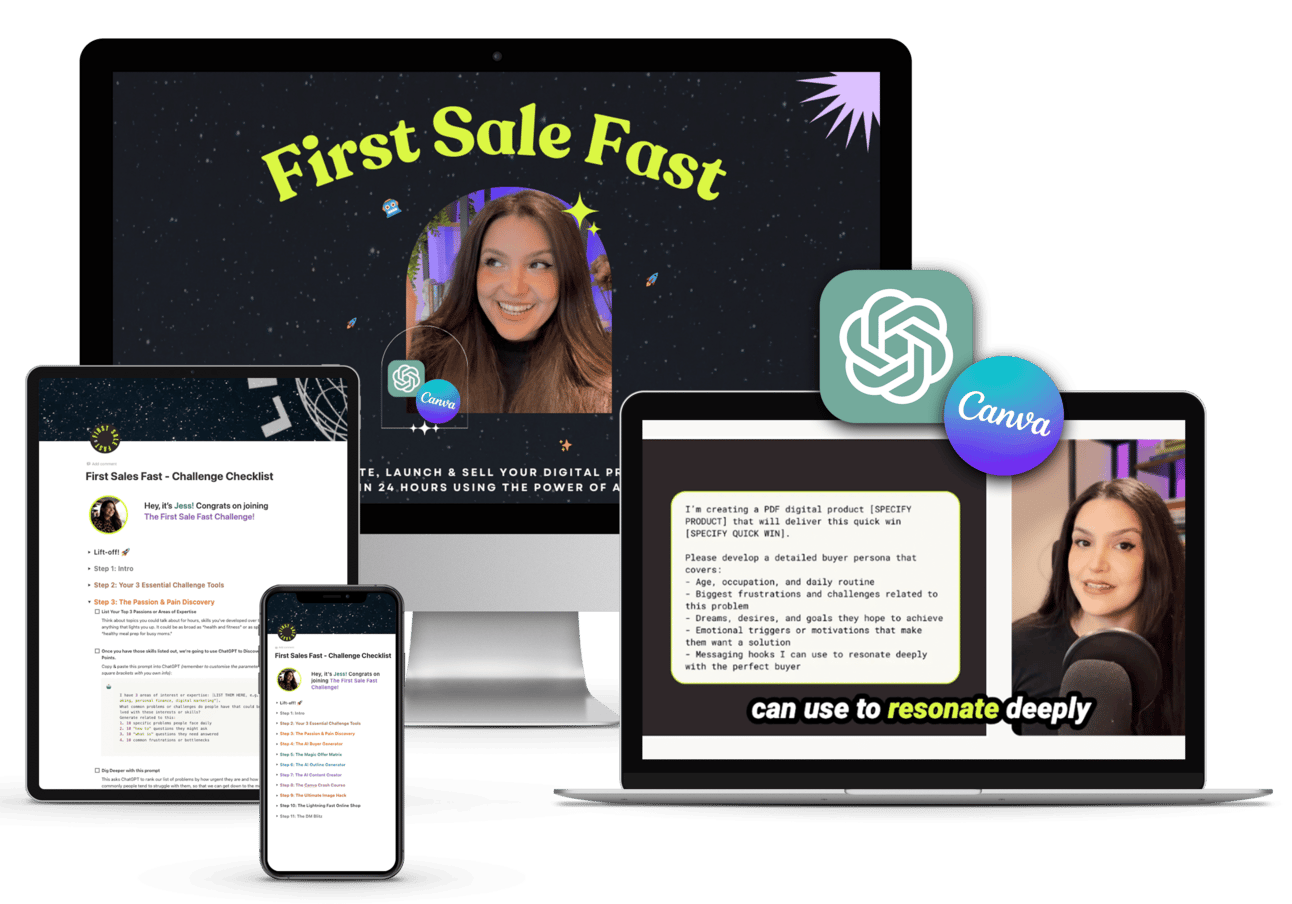
Let’s create your first or next digital product and get it selling in 24 hours with AI and my foolproof 9-step system inside my First Sale Fast challenge!
If you enjoyed today's newsletter AND got to the end of it, I’d love a quick click on the poll below to let me know what you think 💜.
See you next Tuesday,
Jess xx
What did you think of this issue? |